EARLY YEARS
Music and creative health as a first step for families who need it most
IMM has delivered community-based early years music programmes since 2018 and has contributed to practice development, evaluation and partnership working across health, education and community settings. Our parent-and-child music sessions support families with children aged 0–5 in some of England's most deprived neighbourhoods building communication, confidence and connection in places families already trust. Many families first encounter IMM through libraries, Family Hubs, schools, health visitors, GP’s, housing partners or recommendations from other parents before returning regularly over time.
.png)
Why this work, in this place
The communities we serve face the sharpest end of early childhood inequality
The neighbourhoods where IMM works are not randomly chosen. They are the places where child poverty is highest, mainstream services are least effective, and families most often describe feeling invisible, unsupported and alone in the earliest years of their child's life.

IMM Early Years Music Therapy Framework
Our approach combines music therapy practice, early childhood development research and community-based delivery to strengthen parent-child relationships and support positive outcomes for both children and caregivers. The framework below illustrates how shared musical interaction creates opportunities for connection, communication and development across four key outcome areas.
Music is a natural language before spoken language develops. IMM sessions are structured around the building blocks of early communication, rhythm, repetition, call-and-response, shared attention and turn-taking. These are not incidental to what we do. They are the mechanism through which communication develops.
Parent Outcomes 2024–25
Alongside supporting children's development, IMM's early years work aims to strengthen parental confidence, reduce isolation and help families build positive everyday interactions through music, play and shared experiences.
Through feedback, observation and evaluation, parents consistently report:
-
Increased confidence interacting and communicating with their child
-
Greater understanding of how music, play and repetition can support development at home
-
Stronger parent-child relationships and shared enjoyment
-
Reduced feelings of isolation and increased connection with other families
-
Increased confidence attending community activities and accessing wider support
-
Greater use of songs, musical games and interaction techniques within everyday family routines

"I really needed this. I'm in the country alone with my baby and didn't know anyone yet — this helped me meet people and feel connected."
Mother — Woodville Family Centre, Cheetham Hill
Our practice framework — grounded in established early childhood evidence
IMM does not deliver a packaged programme. We deliver a consistent, evidence-based practice with consistent staff, consistent methods, and a clear framework that adapts to the families in the room rather than asking families to adapt to us. Every session, at every venue, contains the same core elements: musical turn-taking, movement, instrument play, song, responsive interaction and unstructured free play. What changes is the language, the songs, and the pace and those changes are led by the families themselves.
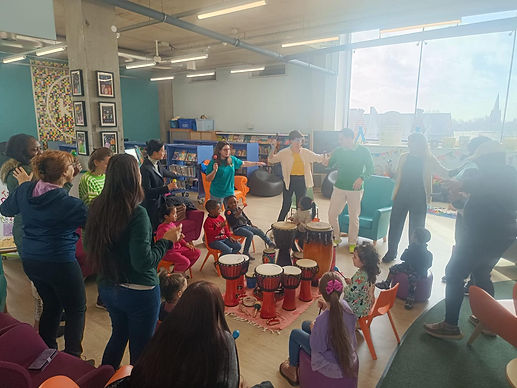
What physical development looks like in our sessions:
-
Babies on laps handling rattles, shakers and soft instruments — developing reach, grasp and fine motor control
-
Toddlers moving freely to rhythm — clapping, stamping, spinning, jumping — building gross motor skills and body awareness
-
Action songs and movement sequences supporting coordination, balance and bilateral movement
-
Tummy time supported through music — babies motivated to lift and turn in response to sound and voice
-
Sensory exploration of instruments — texture, weight, vibration — building tactile and proprioceptive awareness
-
'Free play' with instruments at the end of every session — unstructured physical exploration led entirely by the child
Movement is woven through every IMM session from the first minute. Babies and toddlers explore instruments, reach, grasp, shake, bang and wave. Older children stamp, clap, stretch and spin. Music provides a joyful, intrinsically motivated context for the physical exploration that underpins gross and fine motor development and it does so without the structured, directive approach that can feel clinical or pressured for families already carrying high levels of stress.
Communicative musicality
Research by Trevarthen and Malloch has shown that parent-infant interaction is inherently musical, the back-and-forth of voice, rhythm, gaze and movement is how babies first learn to communicate. Babies communicate through rhythm, repetition, sound, movement and shared attention long before they develop language.
Our sessions use music to strengthen these early interactions between parent and child in ways that feel natural, playful and accessible to families regardless of language or background. The practitioner models the interaction and the parent takes it home.
Reference: Trevarthen & Malloch (2009), Communicative Musicality; Gratier & Trevarthen (2008)
Responsive caregiving and attachment
Our practitioners model warm, responsive interaction, following the child's lead, noticing what captures their attention, and helping parents build confidence in reading and responding to their child's cues. Parents take these patterns home.
The songs, games and responsive play modelled in sessions become part of bedtime routines, transitions and everyday family life. Families with English as an additional language are supported through music, visual cues and non-verbal play.
Reference: Ainsworth (1978), attachment theory; Bowlby; Zero to Three responsive caregiving frameworks
HCPC-registered music therapy
Where families need it, our HCPC-registered music therapists bring clinical experience of working with attachment, regulation, sensory processing and early communication.
This is held lightly within community sessions and more directly in our deepening home-based work.
Our music therapists operate within the professional and ethical standards of the Health and Care Professions Council the same regulatory framework as speech and language therapists, occupational therapists and clinical psychologists.
Reference: HCPC Standards of Proficiency; British Association for Music Therapy clinical guidelines
Cultural responsiveness as evidence-based practice
We do not deliver one fixed programme into every community. We deliver a consistent framework same structure, same clinical grounding, same fidelity to communicative musicality principles that responds to the families in the room. At Wai Yin, songs are shared in Mandarin and Urdu. At the Manchester Jewish Museum, families share songs from their own traditions. At Woodville, lullabies from East Africa sit alongside English nursery rhymes.
Cultural adaptation is not a deviation from the evidence base. It is what makes the evidence base work for families who have been failed by approaches that did not adapt.
Reference: WHO (2019) guidelines on early child development; culturally adapted intervention frameworks
Who delivers our sessions — practitioner competence:
All sessions are led by HCPC-registered music therapists and trained early years creative health practitioners. Many of our practitioners live and work within the communities they serve. Sessions are never delivered by volunteers or unqualified staff.
Research partnerships:
IMM has active research partnerships with Manchester Metropolitan University, Sheffield Hallam University, the University of Southampton and the University of Surrey. These partnerships are actively building the formal evidence base for our approach and will produce published research outcomes over the next four years.
What we are learning
-
Trust takes time. At the Manchester Jewish Museum, our opening session had no participants. By week six we were welcoming 21 families. The lesson: commit to the place, not just the session.
-
Small practical changes matter. At Woodville we added a soft carpet to the session space in week two. Engagement visibly improved. Families with crawling babies could move more freely. Details matter to families.
-
Registration forms can be a barrier. At Wai Yin, formal intake processes kept families away. We are developing lighter-touch data collection that gathers what we need without putting families off at the door.
-
Father attendance is lower than we want. Around 18% of our attendees are fathers or male carers. We are co-designing father-focused sessions with young fathers directly — weekend timing, male-led facilitation, trusted spaces.

Research papers, audits, articles
Re-visioning Music Therapy Skills for Flexible, Sustainable Community-based Group Work
In this article we will set out the IMM EYF model, examine its place within the busy marketplace of baby and toddler activity groups, and discuss how IMM classes can provide integrated care pathways for those with additional needs in their local communities.


Embedded in the local early years ecosystem
IMM is part of Manchester City Council's Family Hub Steering Group, shaping provision for families with children aged 0–5 across the city. We work alongside Early Help teams, Health Visitors, midwifery teams, the Perinatal Infant Mental Health Service and Start for Life across Manchester and Tameside.
MANCHESTER PARTNERS

.png)










.png)